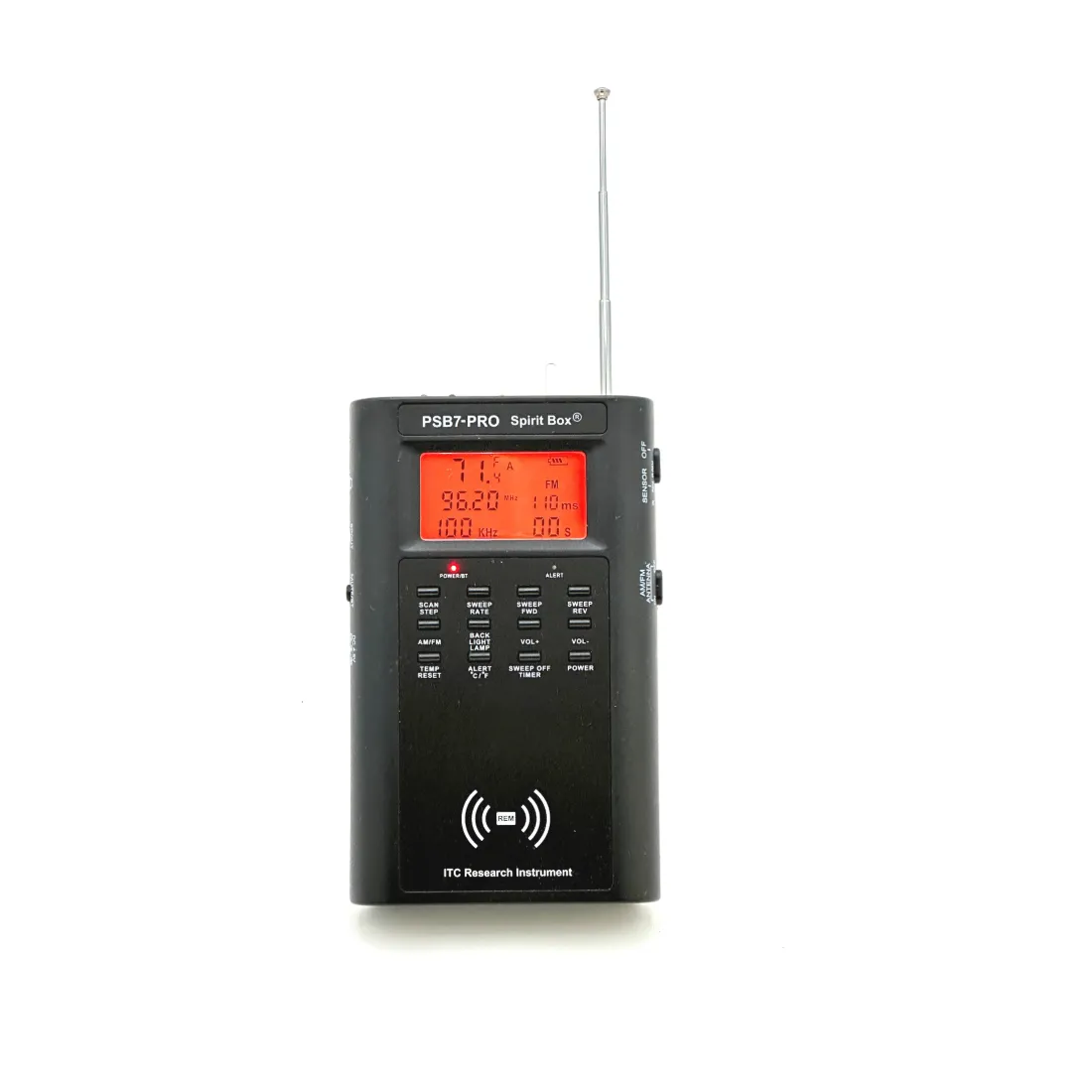
What Is Frequency Overlap? How the PSB7-PRO Creates Clustered Hot Spots
Most spirit boxes give you one control: how fast the radio sweeps. I wanted more than that. When I built the PSB7-PRO out of my RadioX-ITC research, I added a second, deeper control that no production spirit box had before: the ability to adjust the frequency steps the sweep moves through, not just the speed it moves at. I call the result frequency overlap, and it is the reason the PSB7-PRO can create what I refer to as clustered hot spots.
A standard sweep, in plain terms
A frequency-sweep spirit box scans across the AM or FM band, never resting on one station, with a short burst of white noise between each step. Fragments of audio and noise pass by quickly, and a response can form in that changing audio. On a normal sweep you set the sweep rate in milliseconds and that is that. Fast sweep, slow sweep. It works, and it is how the P-SB7 has been used since it premiered on Ghost Adventures back in 2009.
What frequency overlap adds
On the PSB7-PRO you can adjust the sweep speed from 30 to 350 milliseconds and adjust the size of the frequency steps the sweep takes. When you tighten those steps, the sweep revisits a narrow group of frequencies more often instead of racing across the whole band. That narrow, repeatedly-visited group is what I call a clustered hot spot: a small window of the band being fed to you again and again in a very short span of time.
The idea is simple. If a response is going to form, I want to give it more opportunity, in one place, to speak fluently, rather than one quick pass and gone. Overlapping and clustering the frequencies creates a wealth of opportunity in a small window. That is the engineering rationale, and it is why I built the adjustable steps in.
See it in the box
The rest of the PSB7-PRO, briefly
- Adjustable sweep speed, 30 to 350 ms, forward or reverse.
- Adjustable AM and FM frequency steps, the frequency-overlap control above.
- Integrated REM proximity and IR trigger sensors, plus temperature-spike detection, built into the same unit.
Every one of those numbers is real and pulled from the instrument itself. I do not publish a spec I cannot stand behind.
How I frame the results
I share responses in their original, natural form, with no reverb or delay effects added. I want you to hear a response the way it actually came through, so you can get a feel for its disposition and intent. And I am careful with language: these are ITC responses recorded during research, not proof of anything. If you want to hold your own sessions to a higher standard, run controls. Shield out live radio with a Faraday pouch, pre-record the same audio with no one present, and log what you get. Good method makes the compelling moments mean more.
Want to try frequency overlap yourself? The technique lives in the PSB7-PRO Spirit Box, and it pairs naturally with the APF-D Processor for reviewing responses afterward.


