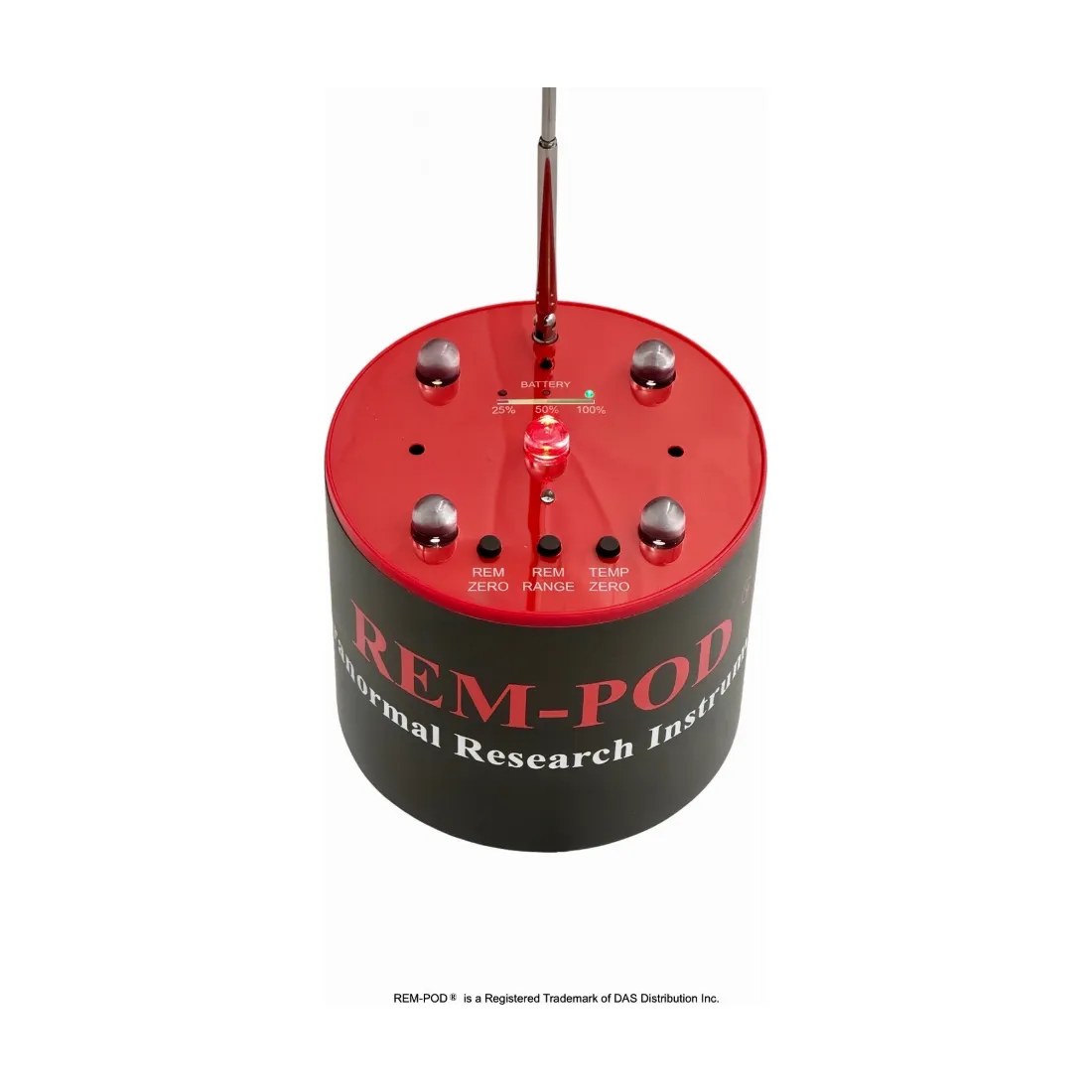
The REM-POD Rev3 Explained: Radiating-Field Proximity Detection for 2026
The REM-POD is one of the most recognized instruments in paranormal investigation, and it works differently from an EMF meter. An EMF meter reads the fields already in a room. The REM-POD makes its own. I designed it in 2010, and it became a fixture on Ghost Adventures around 2011. The latest version, the Rev3, launched on November 1, 2025 as the 2026 Edition.
How radiating-field detection works
The REM-POD uses a telescopic antenna to radiate its own independent electromagnetic field in the space immediately around it. That field is stable and self-generated. When something conductive enters or disturbs the field, the antenna senses the change and the unit responds with lights and tones. Because the field is its own, the REM-POD is looking for disturbances to a known baseline rather than trying to read whatever ambient noise is in the building.
Watch the Rev3 unboxing
What is new in the Rev3
- Manual and automatic baseline calibration, so you set a clean starting point for the session.
- Programmable 5-step sensitivity to match the environment.
- Ambient temperature deviation detection, plus or minus 5 degrees, with a red LED and ascending tone for a rise and a blue LED and descending tone for a drop.
- High-Speed 50 millisecond pulse Field Fringe Detection for faster, finer sensing at the edge of the field.
- Configurable voice alerts, an integrated tripod mount, and a lithium-polymer battery rated around 60 hours.
- An industry-first 18-month parts and labor warranty.
Reading the alerts
The lights and tones are not random. On the Rev3, a temperature rise gives you a red LED with an ascending tone, and a drop gives you a blue LED with a descending tone, so you can tell the direction of a change without looking away from your notes. The 50 millisecond pulse Field Fringe Detection is there for the fast, faint disturbances at the outer edge of the field, the ones a slower sensor would miss between reads. Programmable 5-step sensitivity lets you turn the pod down in an electrically busy building or up in a quiet one, so you are not fighting false alerts all night.
Why an EMF meter is not the same tool
People sometimes ask why they need a REM-POD if they already own a Mel Meter. They do different jobs. An EMF meter is passive: it reports the fields that are already present, which is useful for surveying a room and finding wiring or appliances that could explain readings later. The REM-POD is active: it creates a known field and watches for it to be disturbed. Use them together. Survey the room with the EMF meter first so you know what is normal, then set the REM-POD as a proximity tripwire once you understand the baseline.
Use it with good method
Here is the honest engineering note. Because the REM-POD works with radio-frequency fields, real radio sources can affect it. Handheld two-way radios and phones can trigger a reaction from across a room, and skeptics are right to point that out. So use it properly: set your baseline with the calibration, keep live transmitters away from the pod, note the distance to anything electronic, and log every alert with the time. A REM-POD reaction is data. Context is what turns data into evidence.
See the REM-POD (Rev3).


